
Custom Sterling Silver Jewelry: Casting and Stone Setting
Two operations decide whether a silver design with a stone in it ever becomes a repeatable product: the casting that gives the setting its seat, and the setting itself. Both sit inside the published 25–30 day sampling window, which covers 3D wax printing, precision mould casting, stone setting, polishing and electroplating. The MOQ behind the design is 50 pieces per design in 925 sterling silver.

Key takeaways
- Casting and stone setting are 2 of the 5 operations inside the 25–30 day sampling window.
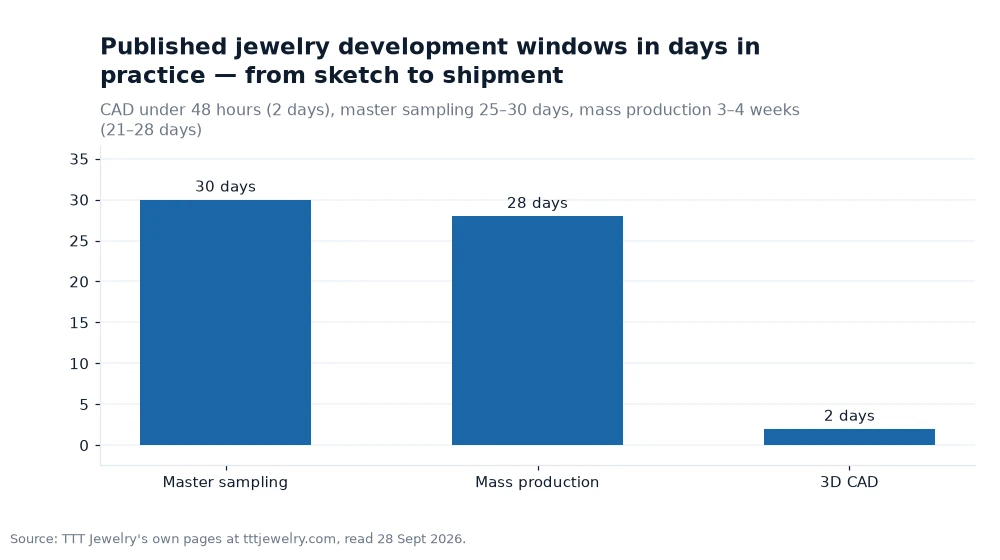
- MOQ is 50 pieces per design in 925 sterling silver; 3D CAD takes under 48 hours and production 3–4 weeks.
- Natural stones and freshwater pearls are both available as accents on a custom design.
- Sample testing lets a physical piece be approved before production starts, and every piece is stamped S925.
What precision mould casting has to deliver
Casting is not a single act. The published route runs 3D wax printing first, then precision mould casting, which means the mould is cut from a printed pattern rather than hand-carved. For a design with a stone, that matters because the seat has to be reproduced at the same depth in every piece of the run, and a hand-finished mould drifts.
The consequence for a buyer is that the setting sits downstream of a decision made at CAD stage. A seat drawn too shallow cannot be corrected by pressing the metal harder at the bench; it produces a stone that sits proud in the first batch and works loose by the third. So the review that matters most is the dimensional sign-off before the mould is cut.
Stone setting on silver, by hand and by design
Setting is a bench operation, and on a 50-piece run it is 50 settings rather than one. The published customisation list includes natural stones and freshwater pearls among the accents a piece can carry, and both behave differently in a setting: a stone holds on its girdle, while a pearl is usually drilled or mounted on a pin, and each needs its own seat geometry.
That geometry is where a design either scales or does not. A setting that needs individual filing to close will show variation across a batch; a setting whose seat is cut into the casting closes the same way every time. When the sample arrives, look at the seat rather than the stone — the seat is what the batch will be judged on.
Where the casting and setting operations sit in the calendar
The sampling window is 25–30 days and contains five named operations, so the two metal-and-stone stages are 2 of those 5. Spread evenly across the window, that is roughly 25 ÷ 5 = 5 days to 30 ÷ 5 = 6 days per operation, and casting and setting together account for about 10 to 12 of the days. Polishing and electroplating fill the rest.
If a design with an unusual seat slips, it slips here rather than at plating. That is why the practical advice is to over-specify the seat on the drawing and, where a stone decision is still open, choose it before sampling starts rather than during the first review.
| Item | Published figure | Why it matters to a setting |
|---|---|---|
| 925 sterling silver MOQ | 50 pcs per design | Number of settings produced per run |
| Master sampling | 25–30 days, five operations | Casting and setting are two of them |
| 3D CAD modelling | Under 48 hours | Where seat geometry is fixed |
| Mass production | 3–4 weeks | Every piece repeats the approved seat |
OEM or ODM for a stone-set design
The two routes are described simply: OEM is "you design, we produce", and ODM is "you inspire, we create". A brand arriving with a finished CAD file and a stone specification is buying OEM, and the work is faithful reproduction. A brand arriving with a mood board and a stone size is buying ODM, where the design work, including the seat geometry, is created for the project.
For a custom sterling silver jewelry OEM order the practical requirement is a complete drawing: setting type, stone dimensions, finish and the position of any mark. Anything left to be decided on the bench is a decision that will be made differently in the second batch, and a stone setting is the last place a brand wants variation.
Silver, the S925 stamp and sample testing
Every silver piece is stamped "S925" to identify it as genuine 925 silver, and the line describes the metal as nickel-free and allergy-free. Plating, where a design uses it, is eco-friendly electroplating in 14K, 18K or 24K gold or rhodium, with an anti-tarnish e-coating available on silver. Compliance sits behind the material with ISO 9001:2015, a BSCI audit and REACH conformity naming lead, cadmium and nickel.
Sample testing is the last checkpoint before production: a physical sample is approved before the batch runs. For a stone-set design that approval should cover the seat, the stone size and the finish, because those three are what the batch repeats — and the repeated version, not the sample, is what a customer eventually holds.
Worked example: two operations out of five
The sampling window names five operations, and casting and setting are 2 of them. As a share of the window that is 2 ÷ 5 = 0.4, or 40%. Applied to the published range, 40% of 25 days is 25 × 0.4 = 10 days, and 40% of 30 days is 30 × 0.4 = 12 days. So a stone-set silver design spends around 10 to 12 days of its sampling window in the two operations that decide whether the setting holds.
Put that next to the quantity. A 50-piece run at one stone per piece is 50 settings, and a 50-piece run at three stones per piece is 150 — the same tooling, three times the bench work, all of it inside the same window. My arithmetic; the five operations, the 25–30 day window and the 50-piece minimum are the published figures.
Frequently asked questions
How many pieces does a stone-set silver design need to start?
The published minimum is 50 pieces per design in 925 sterling silver, and each piece carries the same setting work as the approved sample.
Can natural stones and pearls be set on a custom design?
Yes. Natural stones and freshwater pearls are both listed among the customisation options, and each needs its own seat geometry on the drawing.
When is the setting geometry decided?
During 3D CAD, which returns in under 48 hours for sign-off; changing a seat after sampling means re-tooling and another 25–30 day window.
Getting a stone-set silver design to repeat
Draw the seat, not just the stone. The published route puts casting and setting next to each other inside one window, and the seat is the artefact that carries between them — so it is the detail worth over-specifying on the drawing and checking first on the sample. Then settle the stone itself before sampling begins, since a substitution later is a change to the geometry rather than to a supplier list. A brand running OEM orders should arrive with the seat, the stone dimensions and the finish already specified; the route comparison is set out on the OEM and ODM pages, and the operations that follow setting are described in the factory sequence.
Where the numbers come from — the eco plating route together with the S925 hallmark on every piece, followed by the three compliance statements (ISO 9001:2015, BSCI, REACH) — is the manufacturer's own pages at the tttjewelry.com address, checked 28 Sept 2026. The route comparisons are drawn from those numbers. My re-orderings of the published facts are my own construction, not the site's[1].