
Verifying an Export Document Pack Before a Fragrance Ships
Collecting export documents and verifying them are two different jobs, and only the second one prevents a container from sitting at a port. Verification means checking each document against three things: the product actually shipped, the destination market's requirements, and the other documents in the pack. A premium fragrance launch makes this more urgent rather than less, because the packaging, the claims and often the retail partner's own compliance team all depend on the same paperwork being consistent.
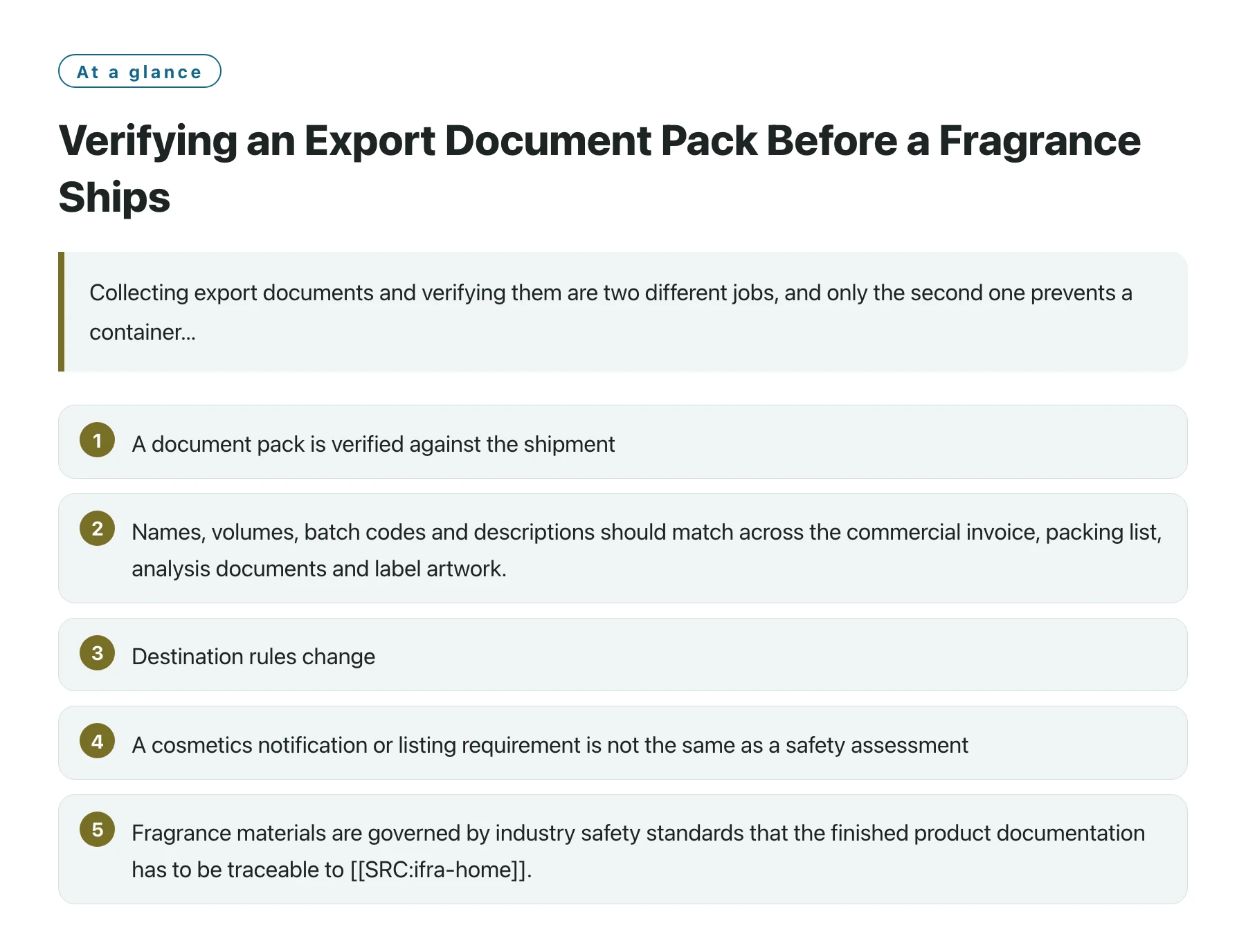
Key takeaways
- A document pack is verified against the shipment, the destination market and itself — the same file can pass one check and fail another.
- Names, volumes, batch codes and descriptions should match across the commercial invoice, packing list, analysis documents and label artwork.
- Destination rules change, so the market you sell into determines which declarations are needed and who is responsible for them [1].
- A cosmetics notification or listing requirement is not the same as a safety assessment, and both are different from a manufacturer's own certificate of analysis [2].
- Fragrance materials are governed by industry safety standards that the finished product documentation has to be traceable to [3].
Most export delays are not caused by a missing document. They are caused by a document that exists, looks complete, and disagrees with another document in the same file: a product description that differs between invoice and label, a batch code that appears on the analysis but not the packing list, or a declaration issued for a different market than the one the goods are entering.
This checklist is written for the person who signs off the shipment, not for a regulatory specialist. It organises verification into four passes that can be completed in an afternoon, and it names the failures that most often surface after the goods have left the factory.
Four verification passes before release
- Pass one: shipment against documentsCompare the invoice and packing list with what was palletised: quantity, fill size, carton count, batch codes and product description.
- Pass two: documents against each otherCheck that the product name, volume, batch code and ingredient description are identical wherever they appear in the pack.
- Pass three: pack against the destination marketConfirm the declarations, notifications and label elements that the destination requires, and confirm who is responsible for filing them.
- Pass four: pack against the launch claimsTest the marketing claims on the pack and online against what the documentation can support, before artwork goes to print.
What to verify on each document
| Document | The verification question | Failure that surfaces late |
|---|---|---|
| Commercial invoice | Does the description match the label and the customs code used before? | A classification query that holds the shipment for days |
| Packing list | Do carton counts and batch codes match the production record? | A receiving warehouse that cannot reconcile the delivery |
| Certificate of analysis | Does the batch code match the goods, and who signed it? | A buyer questioning whether the analysis belongs to this run |
| Ingredient or allergen declaration | Is it current, and does it cover the formula actually shipped? | Label reprint or a market-entry delay after arrival |
| Destination notifications | Has the responsible party filed what the market requires? | Goods that cannot be placed on sale after clearance |
| Safety documentation | Is there a traceable reference for the fragrance materials used? | A retail partner's compliance review that blocks listing |
The pattern in the right-hand column is worth noticing: almost every late failure is a matching problem between two documents rather than an absent one.
The responsibilities question a checklist cannot answer for you
Documents do not assign themselves. Before the first shipment, the brand and the manufacturer should agree in writing who issues what, and which party files any market notifications. On some routes the factory provides technical documentation and the brand holds the market-facing file; on others the manufacturer handles both. Neither arrangement is universally right, but an unassigned document is always wrong.
The destination determines a large part of this. The European Union, for example, operates a framework that places responsibility on a party established in the market, alongside a product information file and a safety assessment [1]. Canada requires cosmetics to be notified to the regulator within a defined period of first sale [2]. A brand selling into both markets therefore needs a file that satisfies two different logics, which is easier to plan before the labels are printed.
Fragrance materials add a further layer. Industry safety standards maintain the lists of restricted and prohibited materials that fragrance houses work from, and the finished product documentation should be traceable back to a current version of that reference [3]. A buyer does not need to interpret the standards personally, but confirming that a traceable reference exists is a reasonable condition to set before an order is released.
Why a premium launch raises the bar on the same pack
Premium positioning usually means narrower margins and longer production lead times, so a delay at the port is more expensive than it would be for a fast-moving lower-cost line. It often also means a retail partner with its own compliance function, which will ask for the file before it will list the product. That review is passed or failed on consistency rather than on the presence of a certificate.
Premium packaging compounds the issue. A decorated bottle, a secondary carton and a gift format each carry their own artwork and sometimes their own supplier, and each version needs to agree with the master documentation. Where the project involves a partner that owns premium production as a specialism — premium fragrance production partner — the practical advantage is usually that decoration, filling and packing sit inside the same document trail rather than across three suppliers.
Safety and stability documentation also deserve attention earlier in a premium project, since a formula positioned at a higher price point often carries larger claims. The technical tests behind those claims are covered in Xuelei's guide, and their results feed the same file that export verification depends on. Building the file as the product develops, rather than at the end, is what keeps a ship date from being decided by paperwork.
Finally, it is worth knowing where the brand itself sits in the chain. A manufacturer such as Guangzhou Xuelei that handles development, production and packing is describing a single trail of documentation, which is easier to verify than a trail assembled from several suppliers — provided the brand actually requests the full pack rather than assuming it is automatic.
Sources
- European Commission: Cosmetics in the EU —— The European Commission's overview of EU cosmetics rules, including the responsible person, product information file and safety report requirements.
- Health Canada: Cosmetic Safety —— Health Canada's cosmetics pages, covering cosmetic notification, the ingredient hotlist and safety requirements for cosmetics sold in Canada.
- International Fragrance Association (IFRA) —— IFRA is the global trade association of the fragrance industry; its site publishes the IFRA Standards, positions and science on the safe use of fragrance materials.
Frequently asked questions
Who is responsible for export documentation, the brand or the manufacturer?
It depends on the contract and the market. Manufacturers typically issue technical documents for the product — formula-related declarations, analyses, material statements — while the brand usually holds the market-facing file and any notification to a local regulator. What matters is that each item has one named owner before the first shipment.
Can a certificate of analysis be used as proof of safety?
No. A certificate of analysis describes the batch that was tested against a specification. It is not a safety assessment, and it is not a market notification. Those are separate documents with separate authors, and buyers should not treat one as a substitute for the others.
What is the most common documentation problem on a first fragrance shipment?
Inconsistent product descriptions. The invoice, packing list, label and analysis sheet are often written by different people at different times, and small differences in naming or volume appear between them. A single master description used everywhere removes most of this class of delay.
How early should documentation work start on a premium launch?
As soon as the formula and packaging are close to frozen, because label copy, claims and declarations all depend on those decisions. Starting at the point of shipment leaves no time to correct a mismatch discovered during verification.
Does a branded claim on the pack need documentary support?
Any claim that a consumer or a retail partner could question should be supportable from the file, whether it concerns the formula, the materials or the product's performance. It is simpler to check that before artwork approval than to defend it after the product is listed.
The right tools change the ritual.
240+ SKUs, hand-vetted by 7 in-house barbers. Free 2-day shipping over $49, and a 100-day guarantee on every order.
Shop the Collection