
Feeding the Profit Calculator: Which Inputs Actually Move the Answer
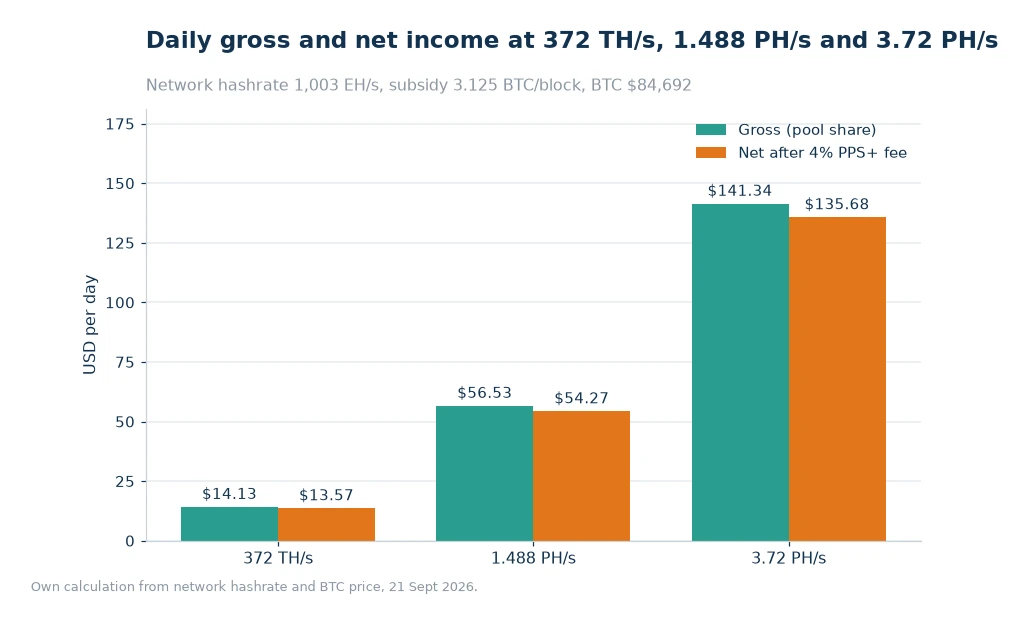
A calculator is only as useful as the four numbers typed into it. At 372 TH/s, with BTC at $84,692 and network difficulty at 132.76 T, the output is 0.00016688 BTC a day, worth $14.13 before the listed 4% and $13.57 after it. Change any one input by a tenth and the answer moves in a way you can predict before touching the keyboard, which is the real value of the exercise.

Key takeaways
- At 372 TH/s the daily output is 0.00016688 BTC, or $14.13 at $84,692 per BTC.
- The listed 4% on the block-reward component takes $0.57, leaving $13.57 a day.
- A 10% higher hashrate adds $1.41; a 10% lower price removes the same $1.41.
- A 5% difficulty increase costs $0.67 a day, which compounds quietly month after month.
Four inputs, one output
The tool takes hashrate, the network conditions behind difficulty, a coin price and the listed fee, then returns an estimate of daily earnings. Everything else in the interface is presentation. Hashrate is the only input you control directly; price and difficulty are read from the market and should always be dated, because a screen showing last week's difficulty is answering a different question.
The output usually appears in coins and in currency, sometimes split by component and sometimes with merged-mining coins folded in. Read the label before comparing two runs. A figure that includes merged-mining output is not comparable with one that excludes it, and a figure that ignores the listed fee will look about 4% better than it is.
Coin selection is the field people skip. The pool supports more than twenty assets, including BTC, BCH, LTC with DOGE merged mining, KAS, ZEC and ETC, and each has its own difficulty and price. An estimate built for BTC says nothing about a KAS rig, and a merged-mining pair produces two income streams from one hashrate. Run the coin you actually mine, then check whether the merged side is included before quoting the number to anyone else.
What each input is worth
The sensitivity table changes one variable at a time from a 372 TH/s baseline and leaves the rest alone. Differences are rounded, but they are large enough to compare, and they show why the order of operations matters: hashrate and price act on the same coin figure, while difficulty acts on the coin figure before price ever gets involved.
| Change from baseline | Gross per day | Difference |
|---|---|---|
| Baseline, 372 TH/s | $14.13 | — |
| Hashrate 10% higher | $15.54 | +$1.41 |
| BTC price 10% lower | $12.72 | −$1.41 |
| Difficulty 5% higher | $13.46 | −$0.67 |
Two rows produce the same movement in opposite directions, which is the useful lesson: a 10% hashrate gain and a 10% price fall cancel exactly. A difficulty increase is gentler per percent but far more persistent, since it rarely reverses for long. Over a year, several small increases do more damage than one dramatic price day.
The fee field deserves care
Most calculators ask for a fee percentage and apply it to the whole output. That is a reasonable simplification for estimating, and it is mildly pessimistic if the real schedule charges a lower rate on part of the income. At 372 TH/s, the listed 4% is $0.57 a day; applying 2% instead would show $0.28, a difference of $0.29. Neither figure is wrong as an estimate, but only one matches the actual schedule.
Use the ViaBTC Mining Calculator when you want the estimate to match the payout you will actually receive, and use a rough percentage when you are comparing hardware and only need relative numbers. Mixing the two is how a spreadsheet ends up optimistic by a few percent in every cell.
Worked example
Do the calculation by hand once, so the tool's output has something to check against.
- Blocks and subsidy: 144 × 3.125 = 450 BTC a day.
- Per TH/s: 450 ÷ 1,003,107,267 = 0.000000448606 BTC.
- At 372 TH/s: 372 × 0.000000448606 = 0.00016688 BTC.
- In dollars: 0.00016688 × 84,692 = $14.13.
- Listed 4% on the block-reward component: 14.13 × 0.04 = $0.57.
- Net: 14.13 − 0.57 = $13.57, or 14.13 × 0.96.
- Scaled up: 3,720 TH/s gives 0.00166881 BTC, or $141.34 gross and $135.68 net.
Every step is multiplication or division, which is the point. If a calculator shows something that cannot be reproduced this way, the difference is usually a field left at its default: a fee of zero, a difficulty from months ago, or a hashrate entered in GH/s while the field expects TH/s.
Where the calculator stops
Three costs never appear in the output: power, cooling and hardware. A 372 TH/s machine at 20 joules per terahash draws 7.44 kW, which is 178.6 kWh a day and about $10.71 at $0.06. Against $13.57 net, that leaves $2.86. A machine at 30 J/TH on the same hashrate would draw 11.16 kW and cost $16.07, more than the credit, and no setting in the tool would warn you.
That is not a flaw in the calculator. Its job is mining output, not the whole business. The discipline is to take the output as the first line of a longer sum, then add the costs the tool does not model. Operators who treat the estimate as profit are the ones who are surprised by a power bill they could have predicted in two minutes.
Watch the real credit for a week before trusting the estimate. The ViaBTC App shows the hashrate and the credited amount without a laptop, and a week of actual numbers will expose any unit error in the model faster than another round of theory.
Reading the answer as a range
Run three cases rather than one: current price, a price a tenth lower, and a difficulty 5% higher. The middle result is the one to plan on, and the worst one is the one to survive. At 372 TH/s the spread between the baseline and the combined bad case is roughly two dollars a day, which does not sound dramatic until it is multiplied by the number of machines actually running.
Date every run. A screenshot from June is a historical document, not an estimate, and difficulty has moved since. Keeping the date in the filename costs nothing and prevents the most common error in this work, which is comparing a fresh number with a stale one and drawing a conclusion about the hardware.
Finally, run the same estimate for any machine you are thinking of buying, at its rated hashrate and its rated efficiency. Two models with the same terahash figure can differ by several hundred watts, and at $0.06 that difference is real money over a year. The estimate tells you what the hardware earns; the efficiency tells you what it keeps, and only the second number belongs in a purchase decision.
Frequently asked questions
What does the Profit Calculator actually estimate?
Daily mining output from hashrate, network difficulty, coin price and a listed fee: at 372 TH/s and $84,692 that is 0.00016688 BTC, or $14.13 gross and $13.57 after the listed 4%.
Should I enter the fee before or after tax?
Enter the pool's listed rate, which is separate from tax: 4% on the block-reward component and 2% on the fee component, giving $0.57 a day at 372 TH/s on the block-reward side.
Why does the calculator disagree with my payout?
Usually a stale difficulty, a different fee assumption or a hashrate entered in the wrong unit; rebuild the figure by hand at 0.000000448606 BTC per TH/s and the gap usually explains itself.
Keep the estimate honest
Write the four inputs at the top of the page, the output in the middle, and the costs the tool ignores at the bottom. That page is a model you can defend, and it improves every time a real statement arrives to check it against. The estimate is not the point; the habit of testing it is.
For the hardware side, compare the tool's output with the Miner Profitability Ranking, which reads current price and difficulty rather than a brochure. If the two disagree by a wide margin, one of them is using an old input, and it is worth finding out which before committing capital.
Sources: the ViaBTC calculator and miner ranking pages for output estimation[1]. Chain data read 21 Sept 2026: network hashrate 1,003 EH/s, difficulty 132.76 T, 3.125 BTC per block, 144 blocks a day, BTC $84,692. Published 22 Oct 2026; power figures use $0.06/kWh and are illustrative.